


3 min read

Counter-UAS Security Requires More Than Just Detection

Counter-UAS Security Requires More Than Just Detection

Friend or foe? The operational layer missing from most C-UAS deployments


The rapid deployment of counter-UAS systems across U.S. cities—accelerated by federal funding for major events like the FIFA World Cup 2026—represents a critical investment in public safety infrastructure. But as agencies finalize their C-UAS procurement decisions, a significant operational gap is emerging: detection alone doesn't create security.


The Missing Middle: Friend or Foe?

Most C-UAS deployments focus on two capabilities: detecting potential threats through radar, RF sensors, and acoustic systems, then addressing confirmed threats through authorized countermeasures. This detect-and-defeat approach seems straightforward. The problem? It assumes operators can instantly determine what they've detected.

In reality, urban airspace is increasingly crowded. On any given day, a C-UAS sensor might detect:

  • Police drones conducting surveillance or emergency response

  • Fire department drones assessing structural damage

  • Utility company drones inspecting infrastructure

  • News helicopters covering events

  • Commercial delivery drones from Amazon, Zipline, or Wing

  • Recreational pilots operating legally in unrestricted airspace

  • Unauthorized drones that pose no threat

  • Actual hostile actors

Without a unified system to determine friend versus foe, operators face a serious coordination challenge. In those instances, public safety personnel must manually cross-reference multiple dashboards—the C-UAS vendor's command and control interface, their fleet management system for agency-owned drones, paper lists of authorized operators in the airspace, and radio calls to neighboring jurisdictions. During a live security incident, those minutes matter.

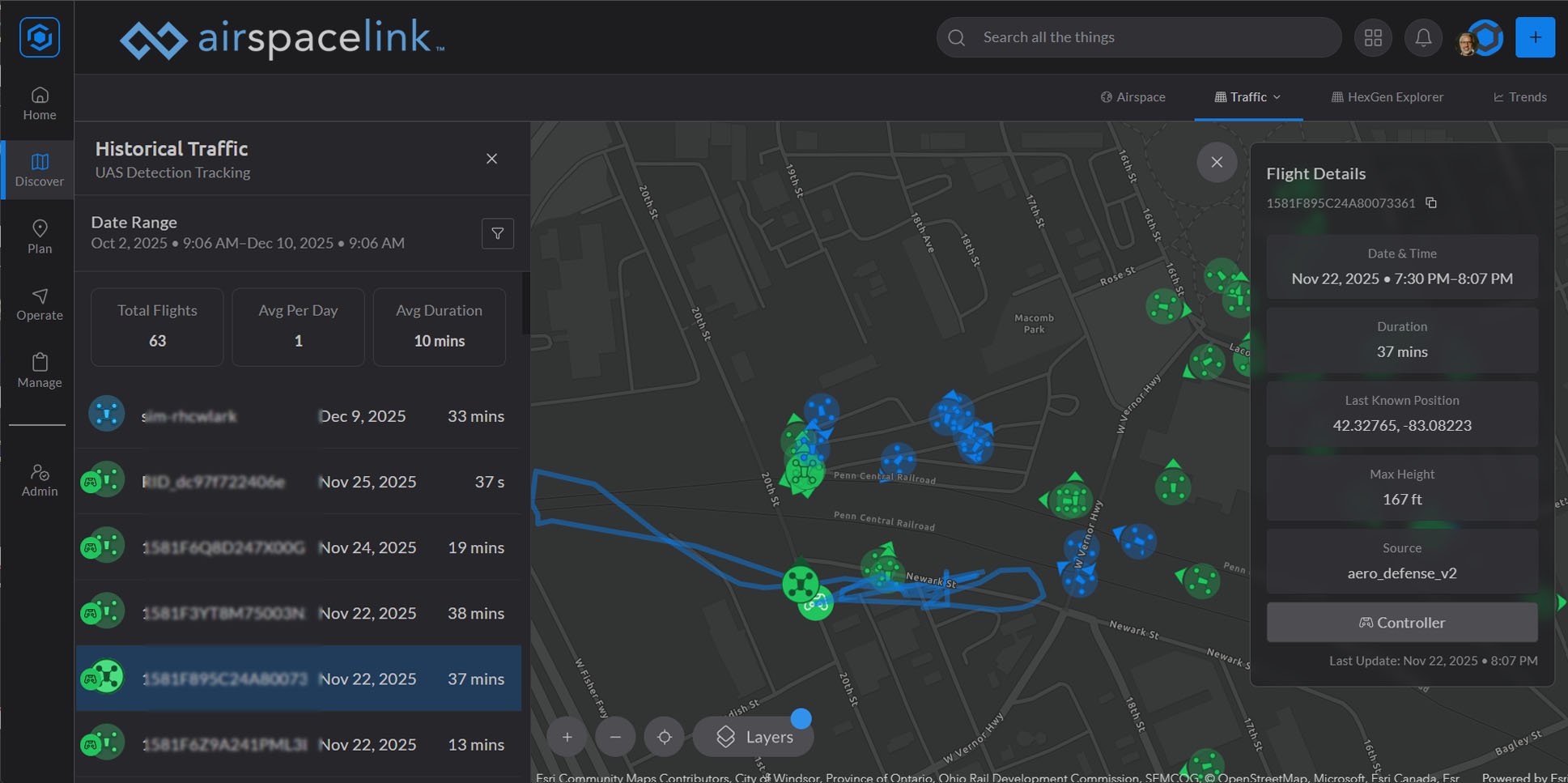
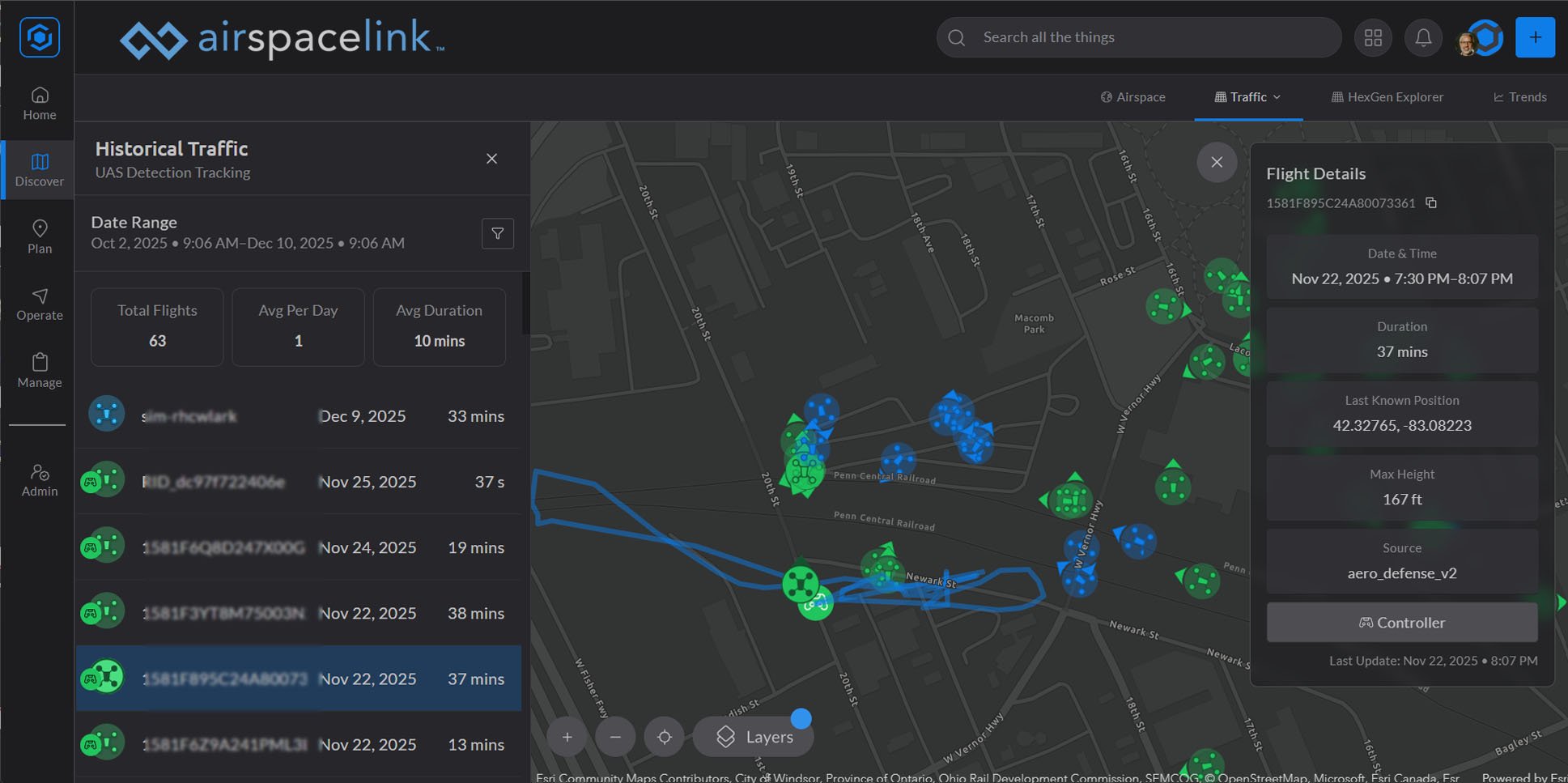
Friend-Foe Drone_Airspace Link1-1

Blue force--i.e. friendly and/or registered drones--as seen in AirHub Portal environment.

 
The Response Coordination Challenge

The operational complexity deepens when agencies deploy their own drones to investigate detected threats. Launching a response drone for visual identification and tracking is often the fastest, most effective way to assess an unknown aircraft and locate its operator. But now the C-UAS sensors are tracking multiple objects, and without integrated visibility, ground teams struggle to distinguish the threat from their own response asset.

This is where the "single pane of glass" becomes operationally essential rather than technically convenient. When a C-UAS sensor flags an unknown drone approaching a secured perimeter, operators need immediate answers: Is this an authorized aircraft from a known operator? Is this our own response drone launched to investigate? Or is this a genuine threat requiring mitigation?


Beyond Detection: Airspace Operations Management

To provide answers in real time, cities need a drone operations management system (DOMS) that sits between detection and mitigation—aggregating data from all C-UAS sensors, all fleet management systems, all authorized operators, and all airspace users into a single operational view.

Airspace Link's AirHub Portal provides exactly this capability: a vendor-agnostic DOMS that integrates across any C-UAS sensor vendor, any fleet management system, and any authorized operator—delivering the unified "single pane of glass" that transforms fragmented detection data into actionable operational intelligence.

This isn't a future requirement. It's a present-day operational necessity, particularly for agencies managing:

  • Multiple C-UAS sensor vendors with different command interfaces

  • Drone as First Responder (DFR) programs with diverse aircraft from various manufacturers

  • Multi-agency coordination across police, fire, emergency management, and federal partners

  • Multi-jurisdictional operations where city, county, and state assets operate in overlapping airspace

  • Commercial operators (Amazon Prime Air, Walmart/Wing delivery services, utilities, media) with legitimate business in the same airspace

A vendor-agnostic DOMS provides what detection vendors alone cannot: real-time identification of all aircraft in the operational area, instant friend-or-foe determination, coordinated response drone deployment, and a defensible audit trail for every operational decision.


The Integration Architecture That Works

The most effective C-UAS deployments treat detection, identification, and mitigation as distinct but integrated capabilities. C-UAS sensors excel at detecting movement and providing threat indicators. Fleet management systems excel at controlling individual aircraft and managing pilot accountability. Mitigation systems excel at neutralizing confirmed threats.

But determining what you've detected—and coordinating the appropriate response—requires a layer that aggregates across all these systems. This is why leading agencies are deploying airspace operations management platforms alongside their C-UAS sensors, not as an afterthought but as a core component of their security architecture.

For cities finalizing C-UAS procurement in the coming weeks, the question isn't whether to integrate operations management—it's whether to build that integration now or retrofit it later when operational gaps become critical incidents.


Proven in the Field

Airspace Link has already demonstrated this vendor-agnostic approach in many of our partner cities, and most recently across multiple high-profile operational deployments. AirHub Portal has integrated with diverse C-UAS sensor manufacturers and remote identification technologies to support security operations at events including the New Year's Eve Ball Drop in Times Square, the US Open Tennis Tournament, and the Blue Angels airshow. These integrations aren't pilot projects—they're operational systems protecting critical infrastructure, managing complex airspace environments, and coordinating multi-agency responses during live events today.

The integration challenge isn't theoretical. Neither is the solution.


Looking Ahead

As commercial drone operations expand rapidly throughout 2026—with Amazon, Zipline, and Wing deploying across major metropolitan areas—the operational coordination challenge will only intensify. Agencies that invest in unified airspace operations management today position themselves not just for immediate security needs, but for the increasingly complex airspace environment ahead.

Detection is essential. But detection without identification introduces operational chaos, not security.


Contact our team directly to learn more about AirHub's vendor-agnostic C-UAS integration and airspace operations management capabilities.


2026 New Year's Letter from the CEO

1 min read

2026 New Year's Letter from the CEO

A Transformational Supercycle for Drones: Carpe Diem (Seize the Day) As we begin the New Year, I want to pause to reflect on a record-setting 2025...

Read More
The Sky Above Your City Just Changed Forever: Your 120-Day Drone Readiness Action Plan

The Sky Above Your City Just Changed Forever: Your 120-Day Drone Readiness Action Plan

Earlier this month, President Trump signed two executive orders that will fundamentally transform the skies above all American cities. Under these...

Read More
$250 Million in Federal Funding Available Now for FIFA World Cup 2026 Host States and Cities

$250 Million in Federal Funding Available Now for FIFA World Cup 2026 Host States and Cities

Application Deadline: December 5, 2025, 5:00 PM ET; Full $500 Million Program to Support All U.S. Cities in Building Drone Security Infrastructure

Read More